
Should you get a Parson’s Chameleon?
Have you ever thought about keeping a Parson’s Chameleon? As exciting as the thought of that is, you are right to think twice. Today I am going to walk you through an introduction that will give you the information you need to make an informed decision about whether to pursue a Parson’s Chameleon
Parsons Chameleon Podcast Episode
Introduction to the Parsons Chameleon
Parson’s Chameleons are one of the most sought after species of chameleons by those who have explored deeper than the common panther and veiled chameleons. And, it is no wonder, Their impressive size, beautiful coloration, and, usually, calm disposition combine to give them the reputation of being the ultimate chameleon. As an experienced chameleon keeper I have to say they actually do deserve all this praise. They are an amazing species and there is just something special about them. It is hard to explain, but keepers of Parson’s Chameleons know what I am talking about.
If you are new to the community and are wondering what this species is that people talk about so much I’ll give you an introduction. Parson’s Chameleons are a group of chameleons from Madagascar. There are two subspecies: Calumma parsonii parsonii and Calumma parsonii cristifer. The parsonii parsonii is the one most people know about and, generally, what people are talking about when they say “Parson’s Chameleon” It is the largest of the subspecies and is widely referred to by locale. You see, even though taxonomic science doesn’t consider them different from a classification stand-point, there are distinct color differences in Parson’s depending on where they come from. And in Parson’s Chameleons we have identified them by the general color appearance rather than where they come from like we do with Panther Chameleons. So, instead of calling it the Ranomafana Parson’s, or Vohimana Parson’s we call them Yellow-lipped, Yellow Giant, Orange-eyed, or Green Giant. The cristifer subspecies is smaller and more rare in captivity.
Although people will always argue the method we use to measure which the largest chameleon is, most of us are content to give that title to the Parson’s Chameleon. You won’t be surprised that size is one of their biggest appeals and is one of their biggest drawbacks. We, of course, will get to that. But they are also attractive in color and usually calm in disposition.
Now, there always has to be another side to everything. If Parson’s Chameleons are so wonderful, why are they not more widespread? Why does every house not come with one? Well, I have done a number of podcasts on the preparation it takes for your standard panther or veiled chameleon. Parson’s Chameleons have they own special considerations! These aren’t good or bad – they are just what they are! So here are eight considerations you should take into account when thinking about getting a Parson’s Chameleons
Parson’s Chameleons Need a Big Cage
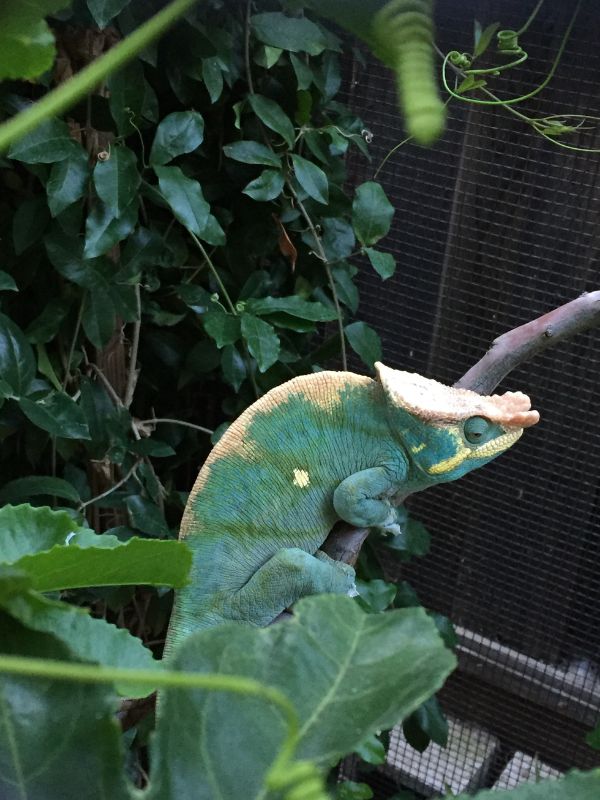
When you think about the Parson’s Chameleon the first thing you think about is how big they are. They are impressive and the first time they settle onto your hand or arm with those back claws you experience a new chameleon keeping sensation. Those claws are strong enough to keep them anchored during the Madagascar cyclones. So, you’ll notice I use a stick for showing them off. But, all of that goodness stakes space. They will need a large cage. 4’ x 2’ x 4’ is the minimum. And, with Parson’s keepers often create walk-in enclosures. Parson’s Chameleons are not necessarily an active chameleon, but they need space to simply exist and find open and hidden areas. They don’t have wildly different needs from other chameleons, but they can be three to four times the mass of a panther chameleon. The question, for anyone considering a Parson’s Chameleon, is why would you want a big chameleon? Is it just to say you have one as a status symbol or is it because you want to enjoy everything that a Parson’s Chameleon is? If you just want to do the minimum as a bragging point then reconsider. And that goes for any chameleon. If you want bragging rights, these days it will be in how good of husbandry you can provide – not how much money you can toss around getting a rare species. So, toss some money towards an appropriate size cage. If it is, as I hope, because you want to experience a Parson’s Chameleon for the wonder they bring, then give them the space to show you their behavior and personality. So, what size cage should you get? If you are going to purchase a cage, go for 4’ x 2’ x 4’ or more. If you are going to make the cage yourself, then don’t settle on the minimum size – ask what the maximum space is you have available and fill it! What about greenhouses? What about large bird cages? Good thinking – good questions. Let’s talk about the next consideration for our answer.

Parson’s Chameleons Need Specific Environmental Conditions
The high level basics for Parson’s Chameleons is that they need conditions humid and cool. By that I mean they do well in the mid 70sF/ low 20s C and with humidity from 50% during the day to 100% at night. Parson’s Chameleons have a reputation of being big drinkers. It is true they need ample hydration and this is amplified if they are kept in dry conditions. Implementing proper humidity and hydration halts this behavior and they no longer drink throughout the day. So, you have to be willing to put effort into setting up and fine tuning their husbandry. Chameleons have the reputation of being delicate. They aren’t delicate, they’re just optimized for their particular environment. And, that environment happens to be arboreal so there is an added challenge for us ground dwellers to relate. We have to be deliberate with the conditions we give them – especially when we further limit the microclimates available by keeping them in a relatively small area. So, you need to be willing to deeply understand how to create environments. The information is here. It isn’t a mystery, but it isn’t easy. And it is by understanding these parameters that you have to be careful what cage you select. A bird cage will be large, but not hold in humidity. A greenhouse may be perfect size, but will it be cool enough? So, if you want a Parson’s Chameleon, or, really, any chameleon, you have to be willing to study how to do it. And, unfortunately, every home will be different so there isn’t a universal answer that is guaranteed to work. There is no way around you having to understand how to create the proper environmental conditions. But humid and cool is where you start for Parson’s Chameleons.

Parson’s Chameleons Need Big Food
This is no surprise! Sure, I have seen a Parson’s Chameleon shoot at a fruit fly just for the fun of it, but you will have to keep appropriate size food available. Now, you don’t have to go crazy on it. Full sized crickets will still be taken, but you’ll want to explore roaches, grasshoppers, walking sticks, etc… Many Parson’s keepers experiment with small birds or rodents, but that is not proven to be necessary. To be sure, vertebrates can be taken in the wild and that will provide preformed vitamin A, but Parson’s Chameleons have been raised effectively on an insect diet. Just keep in mind that a full grown Parson’s Chameleon is larger than the normal chameleon and you will have to be more on top of getting appropriate sized food and enough food. This also means the food may be more expensive. Parson’s keepers often resort to hand feeding to ensure that the more expensive feeders are actually eaten! Parson’s Chameleons do something called brumation where they can go up to six months without eating during a cool period. So, when they are eating they are packing it in to build up for months without eating. Food for Parson’s Chameleons comes with a little more thought than with your standard panther.
Parson’s Chameleons Come in a Smaller Package
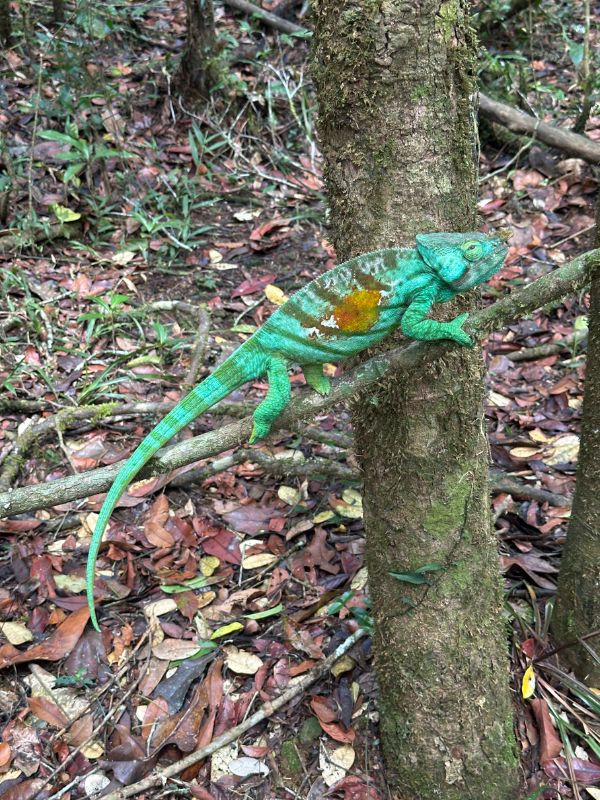
One thing to keep in mind is that Parson’s Chameleons actually come in smaller packages! I mentioned the two subspecies of Calumma parsonii. You have the normal big Calumma parsonii parsonii and the smaller Calumma parsonii cristifer. The smaller version is still larger than an adult panther male, but it will fit easier in a smaller space. So, if you want the Parson’s feel in a more compact form, consider working with Calumma parsonii cristifer or…there is a very charming cousin of the Parson’s Chameleon which is actually one of my favorite chameleon species – the Shamrock Chameleon, Calumma oshaughnessyi. Shamrocks have the Calumma feel, the Calumma look, an even greater palette of colors and are smaller than the average adult male panther chameleon. So, you have options to consider. Shamrocks are kept just like Parson’s so, if you are limited on space, you can still enjoy the Calumma feel.

Parson’s Chameleons Are Expensive
Parson’s Chameleons are readily available, if you know where to look, but they come with a healthy price tag. And this reflects not only how nice they are, but also they do require more care than the average chameleon and their breeding is nowhere near straight forward. The captive hatched market exists, but these breeders have invested tens of thousands of dollars and decades of time to build their skills. Breeding is difficult, incubation is tricky, and raising 40 slow growing chameleon individually is not a cake walk! So, yes, be ready to pay for that. Prices fluctuate but $1500 to $3000 USD is not uncommon. And, it doesn’t stop there. The cage will be much more and the weekly food bill continues for the 20 years of the Parson’s life so…go into all of this with eyes wide open. It isn’t cheap to keep a Parson’s and trying to do it cheaply is a good way for it all to fall apart.

Wild caught vs. Captive hatched Parson’s Chameleons
The great news is that a handful of breeders have figured Parson’s Chameleons out and make captive hatched Parson’s available on a regular basis. Not a constant basis, but once you get infused in the Parson’s community you will notice when clutches become available. Don’t wait until they become available to start making your decision. Come ready to snag one when they become available. The unspoken question is – why not get a wild caught. The answer is that there is a lot of risk that comes with getting a wild caught Parson’s Chameleon. On this podcast, I am going to talk about the quarantine and acclimation of some wild caught Parson’s Chameleons. Although I have decades experience doing this and I, honestly, can’t guarantee that I won’t lose any. Wild caught chameleons come with a host of issues including parasites, sickness, and damage from living life in the wild. Nature is not a nice place. Put Disney movies out of your mind. Nature is trying to kill everything every day. In Madagascar I saw chameleons with mouth rot, missing eyes, battle scars, missing legs, infections, dehydrated…then add the stress of being shipped over and you have a non-ideal health situation. Luckily, importers have worked with exporters and conditions have improved significantly to the point where some of the wild caught chameleons are coming in as pristine as captive hatched chameleons. But, it is a combination of the chameleon’s condition and the export conditions. We only have control over one of those. That is just the export process. Nature has still had its way with them and life is hard out there in the jungle. A captive hatched baby has been raised individually, had all its meals, has never been chased to be eaten by some bird, and gets a chocolate by their perch every night before they go to sleep. Okay, maybe not a chocolate, but the difference in the life they live is night and day. I know they are impressive looking, but leave the wild caught chameleons to the breeders that need them for bloodlines and are experienced with acclimation. Spend the extra money to get a captive hatched individual from these breeders. You are investing in a chameleon that may have 20 years with you. This is a long term investment and it is 100% worth it to invest in the best you can find. Believe me the experience of watching your baby grow up into that impressive adult is an experience in itself and one I would not want to miss. I know they don’t have the horns and colors yet, but they’ll get those soon enough. Don’t wish away the magical experience of watching them grow up.

Parson’s Chameleons have Color Locales
Remember those different locales of Parson’s Chameleons I talked about at thew beginning? Males of those different locales show different colors. Females not he other hand are indistinguishable between the locales. And, this has cause confusion in the breeding scene as breeders have tried hard to keep the locales separate. Locale crosses are just as good as pets and are attractive to look at, but we don’t like that if we cross the bloodlines we lose the differences. So, we highly value the females when they are accurately labelled and identified. As far as the male colorations, you have the gorgeous blues on the Yellow-lipped and Orange Eye’d Parson’s, deep yellow in the Yellow-giants, and green in the huge Green Giant Parson’s. And, of course the rusty sides of the cristifer subspecies. The important thing to know is that they are all cared for the same. Yellow-lips and Orange eyes are the most commonly available as captive hatched, but yellow-giants should be coming available in the near future. Cristifers and Green giants are very rare, but people are working with them so keep your eye out. Now, keep in mind there is tremendous variation within each of these locales so your yellow-giant may have greens or even some bluish. Each will be an individual with their individual color variations so do not expect a certain color scheme…the locales more like guidelines than actual rules. The whole naming of them with respect to the most prominent color in that area actually does us a disservice because it disguises the variability that can occur. Nature just laughs at our attempts to pigeonhole chameleons.

Male vs Female Parson’s Chameleons
- Chameleons are tricky in that they can take 6 to 9 months before you can really get a clue at to their sex. So, you may be in the situation where you have to go with the breeder’s best feeling as to what sex the baby might be. And, I do not know of any breeder that will boast a guarantee that they are right. So, if you want a guaranteed male then you may be paying a extra for a larger sub-adult or adult. I will say that the females are wonderful. They do not have the colors or ornamentation of the males, but one look into those eyes and you know they have the same soul. And, it is that inner soul that makes a Parson’s chameleon more than just a big chameleon.
Final Analysis
So, in the end, the only one who can answer the question – should you get a Parson’s Chameleon is you. Do you have the space, the funds, and the drive to learn how to care for them? They are an amazing experience, but it is only amazing if you have everything in place to do it right.
Should You Get A Starter Chameleon?
Let me address a common question by people who want a Parson’s Chameleon, but don’t want to mess up a huge investment learning how to care for chameleons. Should I get a veiled or panther chameleon first before getting a Parson’s Chameleon. And, this answer is multi-facetted. Yes, it would be a good idea to get basic chameleon husbandry under your belt before investing thousands of dollars in a chameleon and its set-up. But, be careful, it is not fair to the Veiled or panther chameleon for you to treat it as a placeholder. If you are going to get a chameleon to learn with before you get a Parson’s Chameleon then go all in. Invest in the right cage and equipment. And, actually, that is the only way you will really learn and be able to leverage this experience! You have to do it right the first time for the lessons to apply!
Now, honestly, I am not as concerned about the idea of a starter chameleon as I used to be. Even if the end goal is a Parson’s Chameleon, I have yet to see a case where the person starting with a panther or Veiled didn’t fall in love with their “starter” chameleon. The Parson’s always ends up being added to the household instead of displacing the first chameleon. In reality, the initial expense is pretty high for every new chameleon, but the additional weekly cost to keep an additional chameleon is minimal. So, as far as a starter chameleon to learn on – I am reversing my initial thoughts on this. If you have heard me talk about this idea before I discouraged it saying you should dedicate yourself to what you truly want. My fear was that the starter chameleon would be treated like a throw away item. But, that just hasn’t played out. So, I am okay with the idea and cautiously in favor of it providing you truly treat this “cheaper” chameleon with the respect it deserves. This whole idea of rarity and monetary value is our construct. A Veiled Chameleon is just as worthy as a living being as a Parson’s Chameleon.
Final Thoughts
And so, where do we go from here? Well, you have some thinking to do. Find some social media groups that specialize in Parson’s Chameleons to plug into the community. I would hate to be the reason why anyone added Facebook to their lives, but, there are groups there. I do an hour live session on the Chameleon Academy Live Youtube channel twice a week and there are many Parson’s Chameleon keepers that regularly attend so. We are often talking about these wonderful chameleons – along with panthers, veileds Jackson’s, Shamrocks…well, you get the idea!. if you want to ease into the community in a friendly atmosphere where you can ask anything you want – or just listen to the questions people ask, then drop on by. It is free. Just remember, there are two Chameleon Academy YouTube channels. The regular Chameleon Academy channel and the Chameleon Academy Live channel. The live sessions are on, you guessed it, the Chameleon Academy Live channel.
If you have any hesitations or questions with Parson’s Chameleons or any chameleon, just come to a live session. We have people that don’t have chameleons at all attend just for the fun of it. So, all are welcome. If you are trying to remember what is happening when just go to chameleon academy dot com and sign up for the newsletter. You’ll get the up to date calendar sent to your email. And, with that, I am going to send you back into the world. Take care of yourself, be excellent to each other, and I’ll see you next time.